
The Santa Fe World Affairs Forum aims to broaden and deepen understanding of world affairs through small, interactive, professionally led sessions on international issues for a membership of informed individuals.
SFWAF Fall 2026 Programs
25 September 2026:
Carmen J López, “Documenting Truth through Impartial Monitoring When It Matters Most,” is a Consultant for the Carter Center’s Democracy program. Since 1989, The Carter Center has stood as democracy’s guardian, conducting over 125 full and limited election observation missions in 40 countries and three Native American nations while pioneering the techniques that set today’s global standards. Currently, The Carter Center is building a U.S-based election observation network. Mrs. López supports the build-out and co-leads the Carter Center’s election monitoring effort in New Mexico beginning with the November mid-term elections. Read more
22 October 2026:
Siegfried Hecker, Is Nuclear Cooperation with China Possible? Is it Desirable? Center for Nonproliferation Studies, Monterey
To answer these questions, I will review the history of nuclear cooperation between the United States and China going back some 50 years. Although the relationship has had its ups and downs, it has brought significant benefit to both, and to the world. It is endangered again now as Washington and Beijing are choosing competition over cooperation. I will make the case, that in the nuclear arena this points us in the wrong direction. – Siegfried Hecker
Siegfried Hecker, Center for Nonproliferation Studies, Monterey, CA was at the Los Alamos National Laboratory for 34 years, including 12 years as director. He was at Stanford University for 17 years and is now part-time professor of practice at the Middlebury Institute of International Studies at Monterey. Hecker has worked on nuclear matters for most of his career, including having visited all countries with declared nuclear weapons programs, including North Korea. He is the author (with collaborating author Elliot Serbin) of Hinge Points: An Inside Look at North Korea’s Nuclear Program (Stanford University Press, January 2023) and editor of Doomed to Cooperate: How American and Russian Scientists Joined Forces to Avert Some of the Greatest Post-Cold War Nuclear Dangers, Los Alamos Historical Society, June 2016.
18 November 2026:
Ambassador (rtd) Vicki Huddleston, in “1898 to 2026 U.S. vs Cuba – Who Loses and Who Wins?” questions whether the Trump administration’s maximum pressure campaign against the Cuban government will succeed – if the past 128 years are a guide – even if it achieves regime change. As a distinguished career US Foreign Service Officer Ambassador Huddleston served as the principal American diplomat in Ethiopia, Mali, Cuba, and Madagascar and also as Director and Deputy Director of Cuban Affairs at the Department of State. She is the author of Our Woman in Havana: A Diplomat’s Chronicle of America’s Long Struggle with Castro’s Cuba, which is based on her three years in Havana as the head of the American diplomatic mission.
10 December 2026:
Dr. Bette Korber, “Vaccines: Some Biology, Some History, and Vaccine Uses in Outbreaks and for Pandemic Response – Highlighting Ebola and SARS-CoV-2.” Virology expert, guest scientist and LANL Fellow Bette Kobler, works on projects related to viral evolution and vaccines through the New Mexico Consortium and as a scientific consultant for Duke, Harvard and University of Pennsylvania. She retired from LANL in 2023. In her presentation, she will focus on vaccines’ role in awakening our own immune defense mechanisms to protect us from disease, will discuss some incredible vaccine success stories, touch on the history of the anti-vax movement and conclude with the story of the effort that enabled the SARS-CoV-2 vaccine to be deployed the first year of the pandemic and its global impact, and the challenges and promise for vaccines that combat outbreaks of the Ebola virus.
All programs will be held in the SFCC Board Room at the Santa Fe Community College from 12-2. The Board Room (#223) is located in the main administration building. Programs include a buffet lunch, a talk followed by comments and Qs and As from attendees. For registration, payment and prices, please see our Payments page. Parking is free on campus. For additional information and to be added to our email list, please email: sfwaforum@outlook.com.
Programs and Webinars
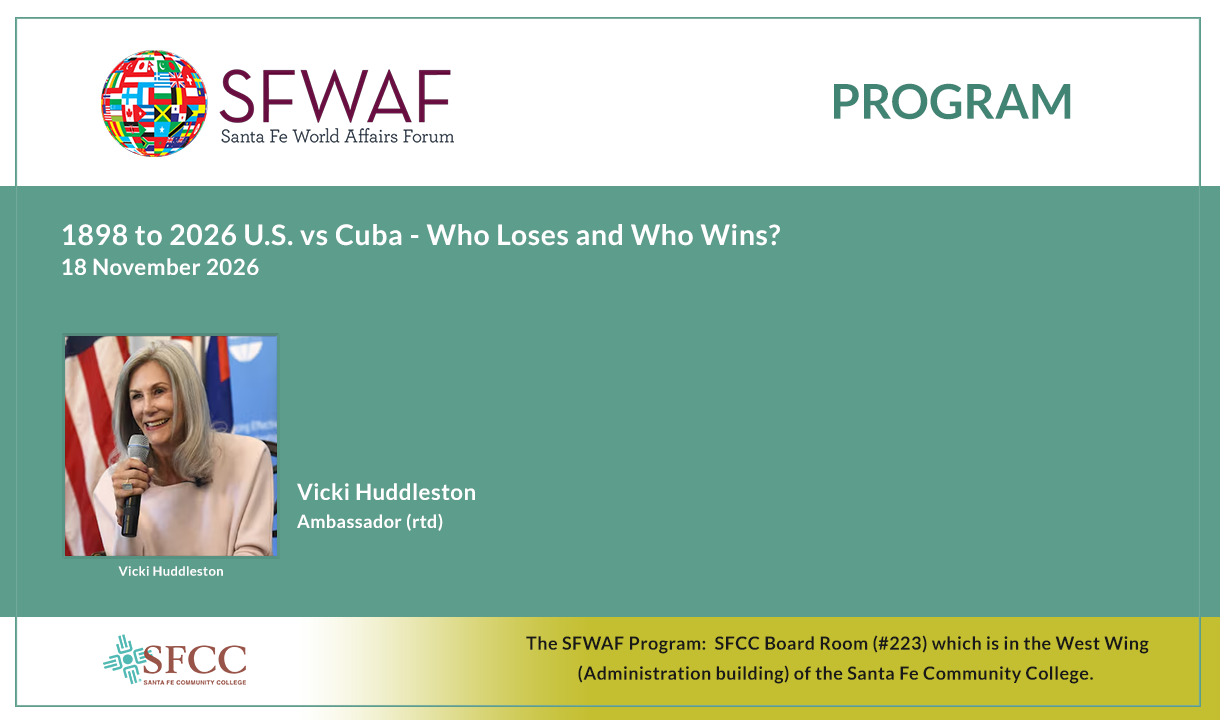
1898 to 2026 U.S. vs Cuba – Who Loses and Who Wins?
Wednesday, November 18, 2026 from 12:00 noon – 2 pm
Vicki Huddleston
Ambassador Vicki J. Huddleston (ret.) has served as the principal American diplomat in Ethiopia, Mali, Cuba, and Madagascar. She is the author of Our Woman in Havana: A Diplomat’s Chronicle of America’s Long Struggle with Castro’s Cuba, which is based on her three years in Havana as the head of the American diplomatic mission.
Ambassador Huddleston served as the Deputy Assistant Secretary of Defense for African Affairs in the Office of the Secretary of Defense as well as Deputy Assistant Secretary of State for Africa. She was the American ambassador to Madagascar and to the Republic of Mali; and head of the American diplomatic mission to Cuba — the United States Interests Section — before it was up-graded to an embassy. She was acting ambassador in Ethiopia, Deputy Chief of Mission in Haiti, and Director and Deputy Director of Cuban Affairs at the Department of State. She was awarded the Department of State’s Distinguished Honor Award, the Secretary’s Career Achievement Award, and two Presidential Meritorious Service Award.
Vicki was chief of party in Haiti for Research Triangle International, a member of the Obama-Biden transition team and a fellow at the Institute of Politics at Harvard’s Kennedy School of Government and an American Political Science Association Congressional Fellow on the staff of former Senator Jeff Bingaman (D-NM). She was visiting scholar at the Brookings Institution, where she managed a project on United States policy toward Cuba. Prior to joining the State Department, she worked for the American Institute for Free Labor Development (AIFLD) in Peru and Brazil. She began her overseas career as a Peace Corps volunteer in Peru.
Huddleston earned a master’s degree from Johns Hopkins School Advanced International Studies and a bachelor’s degree from the University of Colorado.
UPCOMING SYMPOSIUM
April 29-30, 2027
PAST SYMPOSIUM
“Democracy in Danger”

Annual Symposium 2026: Democracy in Danger
April 30 – May 1, 2026
COSPONSORED BY THE SANTA FE COMMUNITY COLLEGE
SANTA FE, NEW MEXICO
PARTNERS INCLUDE: AAUW-Santa Fe; Global Santa Fe; League of Women Voters – Santa Fe County; School for Advanced Research; St. John’s College, Santa Fe (America’s Great Books College); University of New Mexico – International Studies Institute; World Affairs Council-ABQ
To register for the 2026 Symposium, please email sfwaforum@outlook.com with names of registrants, days attending and whether paying by check to SFWAF and mailed to: The Santa Fe World Affairs Forum PO Box 31965, Santa Fe, New Mexico 87594. Or to by Paypal or credit card through our website at https://sfwaf.org/payment
April 30-May 01, 2026
Speakers and Panelists
Rebecca Black; Senior USAID Officer (rtd), Mission Director and Strategic Planning Specialist
Kelly Davis; Vice President for Voter Services, League of Women Voters of Santa Fe County
Dr. Gary Donato; Chair, Santa Fe Veterans Advisory Board
Walter Gaskin; US Marine Corps Lt. General (rtd)
Dr. Siegfried Hecker; LANL Director emeritus, former professor and nuclear weapons expert
Dr. Steve Martinez; History professor, Santa Fe Community College
Dr. Emile Nakhleh; Middle East and Senior National Security specialist
Brian Naranjo; US Senior Foreign Service Officer (rtd), Venezuelan Expert and Strategic Planner
Dr. Mark Peceny; University of New Mexico, Political Science Professor
Gregory Polk; Chair of the Coordinating Committee, New Mexico Peace Corps Association
Karl Stoltz; Public Diplomacy Council of America, Co-president, US Senior Foreign Service Officer (rtd) Public Diplomacy and Disinformation Specialist
Joanna Watkins; Senior Public Sector Specialist, Governance Department, World Bank Summary
Democracy is founded on the idea that the ultimate power of governance lies in its people. In essence, power to govern flows upwards from the bottom not down from the top as is characteristic in autocratic regimes.
Democracy is dynamic. It can adjust to ever-changing environments and societal differences. US democracy is one of the oldest in today’s world, but it is also just one of many forms that have been tried since democracy’s origins in 6th century BCE Athens. Some have succeeded and others failed. Ultimately, all democratic governments provide legal structures. Some do so through written constitutions. Others rely on a set of agreed-upon laws that are underpinned by the values of liberty, independence, free speech, justice and fair play for all and yes, even the pursuit of happiness.
US democracy has changed substantially since it was introduced in the Declaration of Independence in 1776 and the US Constitution in 1789. Both are amazingly concise and revolutionary documents for their time that set out a framework designed to unite 13 disparate, quarreling, multiethnic, multilinguistic and multireligious British colonies governed by a king. This new framework was created to mitigate against the over concentration of power in a single individual or group by dispersing it through a system of checks and balances – from federalism, three branches of government, free media and speech, to regular elections run in the states.
But what if those 17th century guardrails are